
DC Statehood
I don’t think the question should be whether Congress has the authority to make Washington, D.C. a state. The real question is should they.
In the beginning, the United States did not have a permanent capital, and Congress met in a few different cities. President George Washington chose a location on the Potomac River for the permanent capital and the District of Columbia Organic Act of 1801 gave Congress exclusive jurisdiction over the district’s territory.
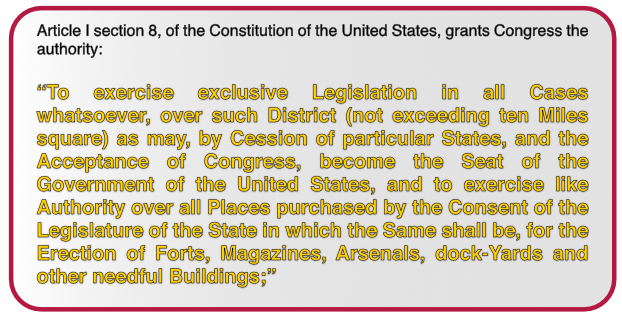
The District Clause, found in Article I of the Constitution, empowered Congress to establish a federal capital district “not exceeding ten miles square” where it would “exercise exclusive legislation in all cases whatsoever.” But some say the Framers made a fateful omission: They failed to provide a means for representation for the district’s future residents.
For me this wasn’t an omission of the Framers but by design. The deficiencies that were inherit when the district was formed were corrected in 1960 when Congress approved the 23rd Amendment, which allowed DC citizens to vote in presidential elections. In addition, the District of Columbia Delegate Act of 1970 allowed DC residents to elect a non-voting delegate to the House and the Home Rule Act of 1973 allowed them to elect their own mayor, as well as a 13-member city council.
Moreover, many who advocate for D.C. statehood ignore the concerns that the District's elected leaders have raised in the past about this prospect. Walter E. Washington, the District's first elected home rule mayor, said converting the District into a state while separating out the existing federal interests “would erode the very fabric of the city itself, and the viability of the city” because the two are so intertwined.
From a practical perspective, the district-as-a-state would lack industries and amenities that are found in almost every other state and which it currently relies on other states or the federal government to provide. Even some scholars sympathetic to converting most of the current District of Columbia into a state and retaining only a small federal enclave consisting of the Capitol Building, the White House and the immediately surrounding areas, concede the Founders never intended for D.C. to become a state.
Yes. The Constitution vests Congress with broad power to admit new states through legislation under Article IV, subject to two limitations: states may not be formed from existing states’ territory without their consent and jurisdictions seeking to join the Union as states must have a republican form of government.
The Framers of our Constitution wanted our nation's capital to be separate and apart from any state. They understood that the seat of our federal government should be a place where all Americans can conduct our nation's business free from the influence of any particular state. Today, the District of Columbia serves that function, as it has for over two centuries and I totally agree with Washington, D.C. remaining the nation’s capital district.
NOTE: A pdf version of this document is available by clicking here !